The Calendar Nailed Beside the Door
The last sound on this bench is the quietest of all: the dry scratch of a flat pencil drawing a line through a finished day.
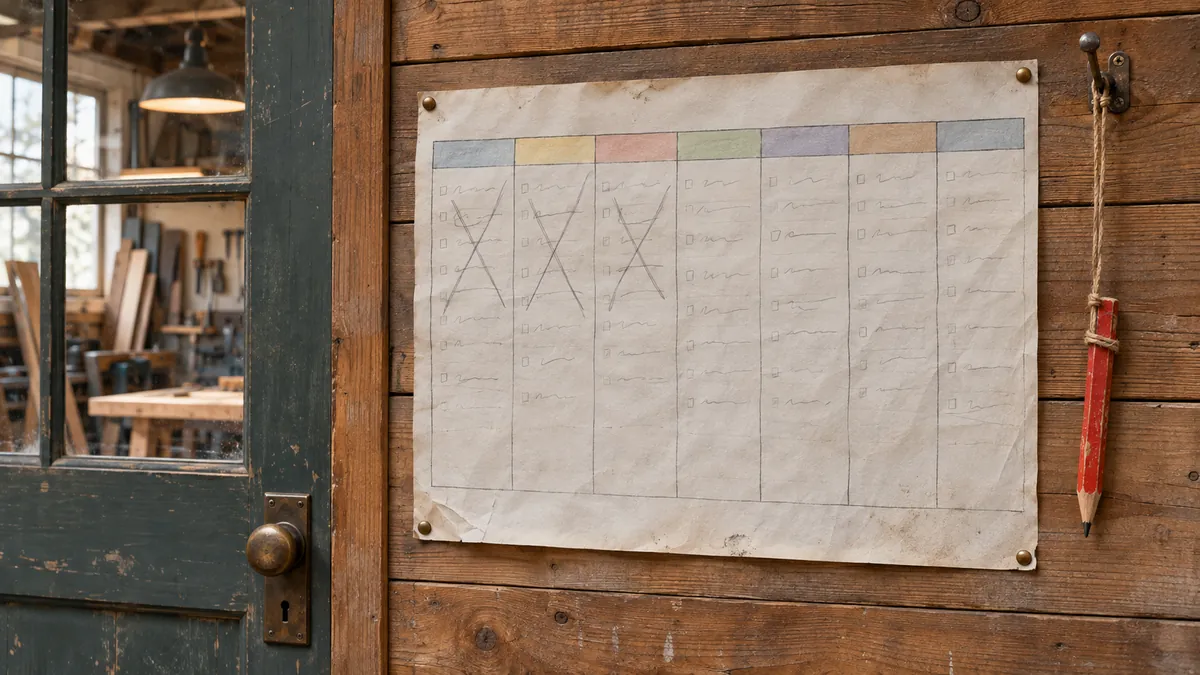
How a small shop keeps its week
Our shop runs on a sheet of paper. It is nothing clever: a printed grid with the days down the left side and a wide space for each one. On Monday morning, before the first machine is switched on, someone writes what each day is for. Glue-up on Tuesday. Finishing room on Wednesday. Delivery on Thursday morning, so nothing big goes on the bench Wednesday night. The sheet hangs on a nail beside the door, with a pencil on a string.
Everyone glances at it twice a day, once arriving and once leaving. On Friday afternoon the person who closes up draws a line through each day that went as planned and circles anything that has to move to next week. Then the sheet comes down and goes into a box, and a clean one goes up.
A week you can see
What makes the sheet useful is not the planning so much as the seeing. A week held only in the head is a blur of half-remembered appointments. A week on paper has edges. You can tell at a glance which day is crowded and which is empty, what is already done and what is still waiting. That takes a surprising amount of weight off the mind.
Plenty of people in later life find that the calendar on a phone, with its alerts and tiny print, does not give them the same feeling of having the week in hand. Paper is slower, and that is part of its value. Writing a plan by hand asks you to think about it once more, and seeing it on the wall reminds you without a single beep.
Setting up your own sheet
Choose one place in the house that you pass several times a day, near the front door or by the coffee maker, and put a weekly sheet there. On Sunday evening fill it in: appointments, calls you mean to make, the day the grandchildren visit, the day the trash goes out. Keep each line short. Tie a pencil to it so there is never a reason to skip a note.
Look at it in the morning and again before bed. On Friday, cross off what is done and carry forward what is not. Keep the old sheets in a folder; looking back through a month of them is a pleasant way to recall where the time went, and some people say it helps them hold on to small events that would otherwise blur together.
The Friday line
The most satisfying moment on the sheet is the last one. In our shop, whoever closes up on Friday takes the pencil off its string and draws one firm line through each finished day. Nobody hurries it. It is a small ceremony, a way of saying that the week happened and was seen. Circled items get copied onto the new sheet before the old one comes down, so nothing quietly disappears over the weekend.
At home, the Friday line can be the same small ceremony. Sit down with a cup of something warm, look over the five days, and draw your lines. Say one thing that went well and one that you want to carry over. Some people like to add a single word in the margin of each day, a name, a place, a meal, so that the sheet becomes a tiny diary. Looking back at those words weeks later is a gentle way to bring the days back into focus.